Ants in the House in November or Winter? It Often Means a Nest Inside
In summer, a few ants in the kitchen are no surprise: they come in from outside looking for food. But in November, December or the middle of January, the picture changes. Outside, the ground is cold or frozen and colonies have slowed down. If ants are walking around your house or apartment at that time of year, they rarely come from far away: there is a good chance that their nest is inside the building, in a heated or damp area. Here is how to read that sign, whether you live in a Montreal plex or in a house in Laval, on the North Shore or on the South Shore.
Why ants in winter are a signal to take seriously
Ants need warmth to be active. A colony living outdoors, in a stump or under a slab, spends the winter almost motionless. A colony living inside a wall, under a floor or in a window frame, on the other hand, benefits from the warmth of the house and can stay active all year. Seeing workers moving around in winter, especially again and again in the same spot, is often a clue that there is an indoor nest rather than a simple visit.
Carpenter ants: a nest in damp wood
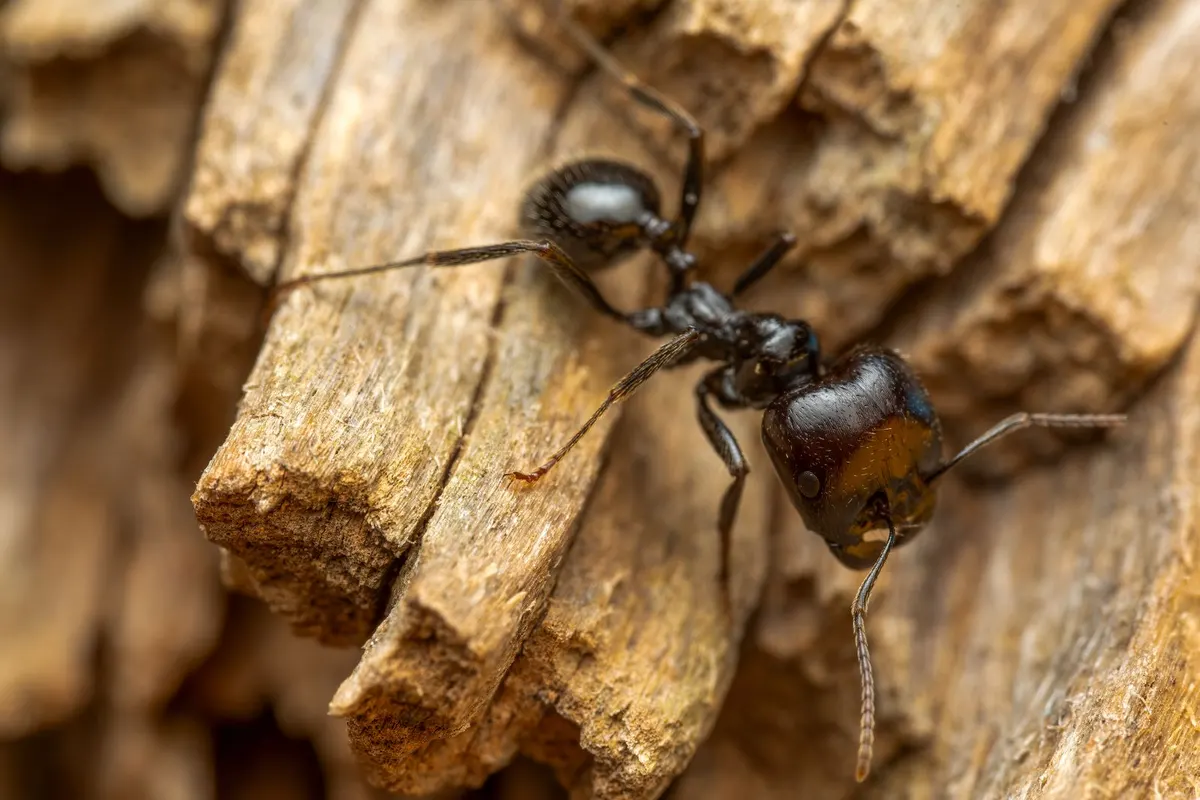
Carpenter ants are large and usually black. They do not eat wood: they dig galleries in it to live, preferably in wood already softened by moisture. In homes in our region, they are often found:
- in floor joists and wood near an old leak, under a bathroom or kitchen;
- in window and door frames where condensation or water gets in;
- under the roof or in the attic, where meltwater has built up before;
- in the wood of balconies, galleries and exterior walls of older plexes.
Pharaoh ants: buildings heated all year
Pharaoh ants are very small and yellowish. They thrive in heated buildings: apartments, plexes, condos and rental buildings. They nest in walls, behind baseboards, near hot water pipes or appliances, and move from one unit to another through ducts and wire openings. For them, winter changes almost nothing: if you see them, the colony is already inside the building.
Signs of a nest inside
- Fine sawdust (called "frass") piling up under a baseboard, near a window frame or in the basement. It often contains bits of insects. It is a typical sign of carpenter ants.
- Winged ants in the house in winter or late winter. Winged ants are reproductives that leave a well-established colony. Indoors, in the cold season, they almost always come from a nest in the building.
- Faint scratching or rustling sounds in a wall or woodwork, especially in the evening when everything is quiet.
- Ants that keep coming back to the same spot: along a baseboard, a counter, an electrical outlet or a pipe.
- Soft or hollow wood when you press on it, around a damp area.
What to do (and not do) in the meantime
- Do not squash them without noting where they travel. Before cleaning up, watch: where do they come out, at what time, in which direction do they go? A photo and a few notes help the technician find the nest.
- Avoid aerosol insecticide. It kills the ants you see, but not the hidden colony. With pharaoh ants, it can even push the colony to split into several nests, which makes the problem harder to solve.
- Do not use bug bombs (foggers). They do not reach a nest hidden in a wall and needlessly expose occupants and neighbours to the products.
- Look for moisture. Check under the sink, around the bathtub, under windows where condensation runs down, in the basement and near the gutters. An old, forgotten leak is often behind a carpenter ant nest.
- Store food in sealed containers and wipe the counters in the evening. It will not get rid of a nest, but it reduces activity.
When to call an exterminator
Call if you keep seeing ants in November or in winter, if you find sawdust or winged ants inside, if you hear sounds in a wall or if you live in a building where ants move from one unit to another. A technician identifies the species, looks for the nest and damp areas, then chooses the right method, for example targeted baits that workers carry back to the colony. They can also tell you which repairs to plan so the wood does not stay damp.
ExtermZone serves Montreal, Laval, the North Shore and the South Shore, 24 hours a day. Call us at (514) 295-7696 for an inspection. To learn how to tell the two species apart, read our article Pharaoh Ants vs Carpenter Ants.